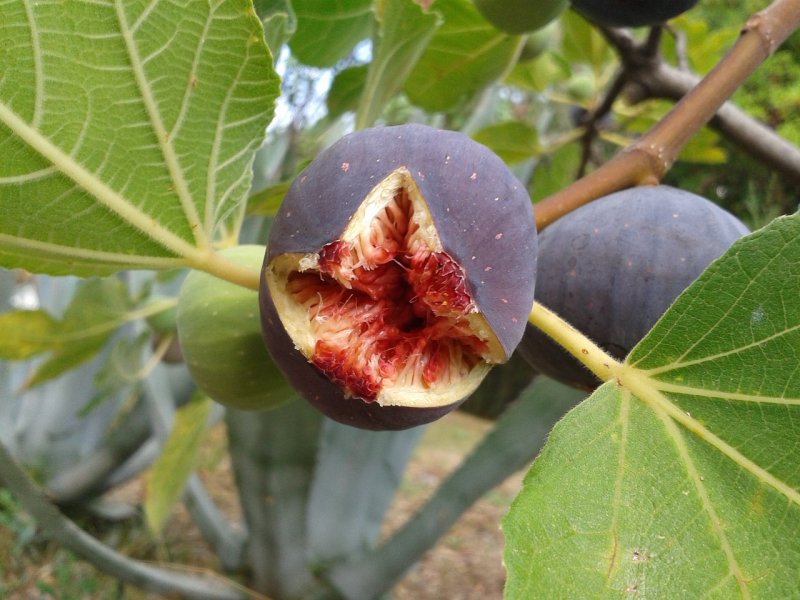
Fig (lat. Ficus carica L.) is known as one of the oldest cultivated fruit species native to Asia, and it belongs to the mulberry family Moraceae. It is a deciduous tree that is widely popular for its juicy fruits, and its lifespan ranges from 50 to 70 years. It grows up to 10 m in height and has a broad canopy with long but weakly branched branches.
Fig is a subtropical fruit species and is sensitive to cold, but tolerates different soil types. As such, it grows best in areas of Mediterranean climate, but can also be grown in continental parts, provided that a suitable microlocation is selected, i.e. a terrain with favorable climatic and pedological characteristics.
Fig flowers are unisexual, have an unusual structure and are gathered within the flesh thickening. Flowers are pollinated by the wasp fig (Blastophaga psenes). Flowering time is from May to August.
Depending on the variety, the fig bears fruits once or twice a year. They are pear-shaped, 3 to 8 cm (1.5 to 4 in) in size, and when ripe, they are yellow-brown or dark purple on the outside and reddish on the inside. It has a very well-developed root system that enables high drought tolerance as well as successful development on uncultivated surfaces. It easily adapts to the soil structure, so in search of water, it can penetrate through cracks in the rocks.
Etymology
Word "fig" comes from the Middle English word "fygge" which is borrowed from Anglo-Norman word "figue", Vulgar Latin "fica", Latin "ficus", Old Occitan "figa" and Old French "figue". Ancient Greeks called it "sûkon" while English sycophant is "tûkon".
The word "fig" was first recorded in English in the 13th century and it was one of the first plants that were cultivated by humans. According to the Hebrew Bible, Adam and Eve used the fig tree leaves to cover themselves after they ate the fruit from the Tree of knowledge (Genesis 2:16-17) after they realized they were naked (Genesis 3:7).
Fig varieties
Varieties of edible figs differ in ripening time: monocotyledonous and dicotyledonous and the color of the skin of the fruit: black and white. Monocotyledonous bear summer-autumn fruits and dicotyledons give the first fruits at the end of June, and the second crop at the end of August. The most commonly grown varieties are Brown Turkey, Fitto ottato, Petrovaca and Sharaguja that originates from Croatia, Celeste, Chicago Hardy, Weeping Fig, Creeping Fig Indian Banyan, Cluster fig, and Fiddle leaf fig
Brown Turkey
The brown turkey fig is a species that belongs to the common fig tree (lat. Ficus carica) and can be cultivated as a shrub or a small tree. It provides sweet edible fruits that can be found at supermarkets. As a young tree, it is green, but after it matures it becomes deep purple with a velvety exterior. The fruits are soft, orange-pink with rich sweet flesh.
It ripens at the end of the summer or beginning of fall and is cultivated mostly for its ornamental look but also abundantly produced fruit. It is known for its hardiness which is why it is suitable for planting in a wide range of climates. The tree grows quickly and easily and should be pruned regularly each spring.
Fico ottato
Fico ottato originates from Italy and has a lush tree and abundant yield. It blooms twice a year, in the spring when it degenerates female flowers that are fleshy and grow to normal size but are not edible, and summer bloom when it develops an edible fruit that ripens in early August. The fruits are suitable for transport, fresh consumption, but also dried, and weigh from 40 to 70 g (1.5 to 2.5 oz). It tastes sweet and very juicy.
Petrovaca
Petrovaca or Petrovka white is a popular Croatian species that has a lush tree and blooms twice a year. The weight of the fruit is from 60 to 100 g (2 to 3.5 oz) while the skin is light green. The flesh is pale pink, juicy and sweet. They are very sensitive to transport due to their juiciness.
Sharaguja
Another popular species that originate from Croatia and is the best variety of monocotyledonous species recommended for market cultivation. It grows well on less fertile soils and the trees are very fertile and moderately lush. The fruits ripen from mid-August to mid-October, and it is necessary to pay attention to the harvest during the autumn months because the fruits are prone to cracking after rain.
The skin is reddish-purple in color, and the flesh is white-yellow with a red center and is very juicy and sweet-sour in taste. They are good for fresh consumption.
Celeste
This species tolerates lower temperatures, which is why it’s known for its hardiness. Thanks to its ability to withstand both hot and cold climates it’s mostly grown throughout the southeastern US. Celeste produces fruits that start out green and as it ripens it becomes brown-purple. Ripe fruit should be harvested on a daily basis and kept in a dry, cool place. They are self-fertile which is why they’re a good option for smaller yards as you only need one fig tree.
Chicago Hardy
Although it is less popular than Brown Turkey fig and Celeste, this species is considered the hardiest of all species. Its branches can withstand cold temperatures. And even though the tree may look like it’s dead during winter, as long as the roots are well insulated the tree will recover in early spring. It produces fruits twice a year, in spring and early fall that is sweet with red juicy flesh. This is a great species for cultivating in containers.
Weeping fig
Popularly grown as a houseplant, this fig tree is also suitable for grown outdoors in mild climates. It’s native to the Pacific, Australia and Asia. The tree is evergreen and can be grown as a tree or a shrub. During summer, the tree blooms with yellow to creamy colored blooms. If grown indoors it will rarely produce fruit, but if grown outdoors it will produce yield twice a year.
Creeping fig
As the common name suggests, this species is a trailing or climbing plant that covers ačmost everything it touches. It can become intensive if you allow growing without pruning. Although it grows relentlessly, the plant will be a nice addition to your garden. It bears purple fruits which can appear throughout the entire year and produces much less fruit than other fig species.
Indian Banyan
Native to India, Sri Lanka and Pakistan, this tree is one of the species known as "strangler fig" as it can grow out of cracks of a matured tree, wrapping itself around the branches and trunk of the original tree. It is epiphytic such as orchids which means it can grow on other living species.
Cluster fig
Also known as the "Red leaf fig" as its foliage is red and the tree’s fruits adorn the branches in tight clusters. It’s native to the South Pacific and Australia and loves hot climate areas. Although it is not commonly grown outside mentioned areas, it is a popular fig hybrid worth of mentioning.
Fiddle leaf fig
Same as Indian banyan, this species is also considered a "strangler fig". Native to Western Africa it typically starts its life as a host of a tree in the cracks growing around it and smothering it. However, it works well as an ornamental tree. It loves warm climates and is popular as a houseplant.
Planting fig tree
As for any plant, before planting it is necessary to determine the requirements of the species according to temperature and soil type, select suitable terrain and prepare the soil for planting. The most favorable areas for planting figs are plains or slopes facing south and southeast.
Best time to plant
Planting time depends on the type of planting material, i.e. rooted seedlings can be planted during the dormancy of vegetation (from November to March), while cuttings are best planted immediately after cutting from the parent tree, i.e. in February.
Planting from seeds
It is not advisable to plant fig trees from seeds as such cultivation method is long and unthankful as the trees yield in 8 to 10 years.
Planting seedlings
Before planting, shorten the roots and soak the seedlings briefly in a pot with a mixture of clay soil and manure. Place a layer of soil on the seedling to cover the root and compacts so that there is no air space. Then apply the fertilizer and the rest of the soil and water it.
Greenhouse cultivation of figs is possible only if you ensure optimal conditions, i.e. the need for light and water and an adequate distance between and within the rows. Grown in such conditions you can have two harvests per year. Nevertheless, this method of cultivation is usually not recommended because the fig tree overshadows the space with its lushness.
Growing in containers
It is possible to plant a fig in a container, just keep in mind that it needs to be kept in a greenhouse during the year or brought indoors when the tree loses its leaves. The area facing south or southwest is most suitable for this type of cultivation.
Propagation
Figs can be propagated in three ways by cuttings, grafting and seeds.
Propagation by cuttings
From mid-January to the beginning of February, take the cuttings approx. 20 cm (8 in) long from the parent trees. Store them in traps at a temperature of 5°C (41°F) in moist sand until spring when they develop the root and then replant them in containers with fertile soil or substrate. Leave them for a year to develop as well as possible. Thus, obtain rooted annual seedlings that are ready for planting on a permanent production area.
There are also cuttings that are immediately ready for planting and are obtained by cutting a woody branch 15 to 20 cm (6 to 8 in). It is necessary to leave the most developed twig while others should be cut off. Such a cutting should immediately be placed in the prepared pit so that only the left twig protrudes from the ground. When planting, it is necessary to enrich the soil with manure or peat.
Propagation by seeds
Trees grown from seeds yield very late, in 8 to 10 years. They are usually uneven in growth, root system development, fruit quality and fertility.
Propagation by grafting
The most common propagation method is grafting and budding on the sleeping bud. Prior to grafting, it is necessary to prepare the lateral branches 15 days before the process.
Growing fig tree
Quality soil, enough water and nutrients are key to growing figs. Quality and thorough tillage is required and based on the analysis of the soil, the required amounts of fertilizer that are needed during cultivation are determined. Fig tolerates lack of water, but a quality yield requires water supply through irrigation, especially on poor quality soils.
Good companions
It is well known that insects love fig trees, especially when the tree is fruiting, so having rue, comfrey, mint, stinging nettles, and marigolds underneath will work well as a repellent. If you love flowers, you can plant rhododendron underneath the fig tree, as in the summer the green leaves of the tree will provide a nice backdrop for the bright flowers, but keep in mind that even the smallest piece of root will grow a new plant and is a very invasive plant
Strawberries will be a great companion to the fig tree. They grow well under the tree and are useful as the extra mulch helping in conserving moisture in the soil.
Perennial geraniums, rosemary, lavender, thyme and chives are also great for fig trees.
Temperature
To determine the optimal average annual air temperature, it is necessary to monitor the temperature extremes. The optimal temperature must be above 12°C (53°F). High temperatures are desirable during ripening because, with a sufficient amount of water, they favorably affect the development and quality of the fruit, so the fig gives the best fruit at a temperature of 38°C (100°F).
Resistance to low temperatures depends on the maturity of the soil and humidity. Older trees can withstand temperatures down to -17°C (1.4°F), while young ones can freeze at -8°C (17.5°F).
Soil
The highest quality soils for growing figs are loose, lighter and carbonate soils, but they can be easily adapted to all soil types due to drought tolerance, iron and calcium deficiency as well as salinity. Alluvial and red soils suit it well. The optimum pH is 6 to 7.8, and requires a good supply of phosphorus and potassium.
Preparing the soil for planting
Before planting, it is necessary to level the terrain, clear the trees, remove stones and plant debris from the soil as thoroughly as possible for better root development. Due to the compaction of the soil, it is necessary to rigolate the entire surface, i.e. deep loosening, at the latest in the summer preceding the spring planting.
Lighter soils should be loosened to about 60 cm, while heavy soils need to be loosened to a depth of 80 cm (2.5 ft). It is necessary, dig pits 50 x 50 cm (1.6 ft) at a depth of 35 to 40 cm (1.3 ft). If the entire surface has not been treated, the pits should be larger, at least 1.5 m (5 ft) wide and 60 to 80 cm (2 to 2.5 ft) deep. It is necessary to adjust the size of the pit to the root of the seedling so that it does not bend and is not damaged during planting.
The distance of seedlings between and within rows depends on the growing form, variety, desired planting density, soil fertility, etc. The usual distance between rows is from 5 to 14 m (16 to 46 ft), and within rows from 4 to 12 m (13 to 40 ft).
Fertilization
Before planting, make sure to do a soil analysis to determine the amount of phosphorus and potassium required for reclamation fertilization that is primarily required on poor and medium-supplied soils. As for regular fertilization, 600 kg/ha of phosphorus and 700 kg/ha of potassium should be added to the soil as well as NPK fertilizers with minimum nitrogen content (NPK 5:20:30). Heavier soils need to be enriched with organic matter, primarily nitrogen. After summer loosening, it is recommended to sow and plow manure in the amount of 40 to 50 t/ha.
Figs can also grow on poorer soils due to their highly developed root. They draw water and nutrients from the deeper layers of the soil, but fertilizer is still needed for a better yield. On poorer soils, apply 2,300 kg/ha of NPK 5:20:30, and during the fall, apply organic fertilizer such as manure.
Irrigation
In conditions of lack of water, the tree can crack and development of fungal diseases can occur. Apply drip irrigation system, and depending on the rainy periods and soil type, the amount of water for irrigation per season ranges from 250 l/m2 to 700 l/m2 (6.5 gal/ft2 to 18.5 gal/ft2).
Plantation maintenance
After planting, make sure you prune it regularly in order to obtain the desired cultivation form. The grass around the fig tree also needs to be mowed regularly and spread the fertilization around the tree 3 to 4 times a year.
Pruning
After the first harvest, it is necessary to prune the tree every following year in order to maintain the good condition and health of the tree. This should be done mostly in summer and winter.
There are several types of pruning in figs:
- Thinning - removal of shoots to the base
- Shortening - shortening the length of shoots
- Bending - bringing the shoots to the appropriate angle of branching relative to the main branch
Pruning for early blooming species is done after harvesting and in irrigated conditions while for late-blooming species pruning should be done in May. In intensive fig cultivation, naturally shaped canopies are most often, and it is recommended to remain the shape of a vase with three basic branches.
Fig harvest
Figs begin to bear fruit in the third year after planting, and a significant yield will be possible from 5 to 7 years. Harvesting takes place from June to October on several occasions due to the uneven ripening of the fruit. They are harvested with a stalk and after that, they do not have the ability to ripen.
Ripe fruits are recognizable by their size, skin color and firmness and taste of the flesh. The maturity of the fig can also be assessed by the weight or hanging of the fruit on the branch. The skin should be easily separated from the meat. It is important to pick figs gradually as they ripen because the fruit can be overripe in a few days. It is best picked in the early morning. Also, keep in mind to wear gloves for protection as fig milk can irritate the skin.
Storage
After harvesting, the fruits should be stored in shallow marked containers to prevent contact and spoilage. Store them in refrigerators at a temperature of 0 to 4°C (32 to 39°F) with a relative humidity of 85% from 15 to 21 days, depending on the species.
Drying
The fruits that are picked for drying must be fully ripe for drying because this is when the fruit is most enriched with the highest sugar content. They can be dried in the sun, or in kilns. To prevent the appearance of mold, fungi, bacteria or flies, the fruits should be sulfured before drying or immersed in seawater.
Diseases
The most common diseases that occur in figs are gray mold, black-spotted fruit, fig mosaic, and root rot.
Gray mold
Gray mold (lat. Botrytis cinerea) attacks primarily the fruit and young shoots causing fruit rot and drying of the shoots. Large gray-brown watery spots appear on the fruit, which spread quickly resulting in rots and falling off. The disease occurs in conditions of excessive humidity, so a preventive measure of crown pruning is recommended.
Black spot
The black spot of fruits (lat. Alternaria fici Farm) occurs on the surface of the fruit. You will notice bright spots that darken over time, and the fruit is covered with fungal mycelium that penetrates into the interior causing the fruit rots. A preventive measure in the form of pruning is recommended because the disease occurs in conditions of excessive humidity.
Fig mosaic
Fig mosaic (lat. Ficus virus) attacks branches, leaves and fruits. The infested branches are thinner and shorter and the diseased leaves are recognizable by their light yellow spots. The leaves are gradually deformed and dried, which reduces the resistance of the tree to diseases and pests. This disease is dangerous because it attacks all parts of the tree and control is done only preventative, by planting healthy plants.
Root rot
Root rot (lat. Rosellinia necatrix and Armillaria mellea) is a fungus that causes root rot in newer plantations and is transmitted by root remains of previous crops. The disease cannot be treated because it completely destroys the tree, so it is very important to thoroughly clean the terrain of plant debris before planting.
Pests
The most common pests are fig flea, fig moth, fig mead and small fig bark beetle.
Fig Psylla
Fig Psylla (lat. Homotoma ficus) is an insect 3 - 4 mm (approx. 1/8 in) in size that attacks the leaf and sucks the sap, which weakens the whole tree. It usually appears in May and June on the back of the leaves secreting honeydew, which increases the likelihood of developing soot. It is controlled by winter spraying with oils, and insecticides based on dimethoate, diazinon and malathion.
Fig leaf roller
Fig leaf roller (lat. Simaethis nemorana) damages the leaf tissue by eating it which weakens the lushness of shoots and creates a basis for the attack of other pests. It rarely occurs in significant numbers, so control is generally not needed, but if necessary, it should be treated with the same treatment as for the control of Fig Psylla.
Fig wax scale
Fig way scale (lat. Ceroplastes rusci) - thyroid aphid which is the most important pest of figs. It lives under a shield and reproduces quickly. It depletes the tree by sucking the sap, and covers the fruits, leaves, and shoots with the bodies. It abundantly secretes honeydew, which is a suitable condition for the development of soot. Control is carried out by winter spraying with white or blue oil, which also works against diseases.
Fig bark beetle
Small fig bark beetles (Hypoborus ficus) attack branches and twigs causing damage by drilling tunnels under the bark. Preventive agro-technical measures are needed in the form of removal of infested branches from plantations which then should be burned.
Fig uses
The fig fruit can be consumed fresh and dried or processed into jams and similar products. It also has anti-inflammatory and antioxidant properties.
Use in cooking
The best way to enjoy the fullness of fig flavors is to eat them fresh. Wash them briefly under water and carefully wipe them with kitchen paper. Serve them at room temperature whole or cut into four pieces as a dessert fruit. Fresh figs contain a high proportion of water and natural sugars, so it is useful in recovery from exhaustion and detoxification. As an appetizer, they can be served with prosciutto on an arugula salad with parmesan leaves, sausages or briefly fried with bacon.
They combine perfectly with nuts such as walnuts, pistachios and almonds, so they are excellent as an addition to cheese platters with grapes. You can also stuff the middle part of the figs with a salty filling, made of cheese, such as roquefort, feta or goat cheese, celery, and sweet fillings made of mascarpone, in which you mixed honey and finely chopped nuts: marzipan, walnuts, raspberries or raspberry mousse.
Figs can be poached in red wine, honey or sugar syrup, caramelized or baked with butter.
You can serve them with meat or poultry dishes, and if you coat the fig halves with honey before putting them in the oven, you can serve them as a dessert. You can also make caramelized figs and a great complement to savory dishes. Roasted duck breast can be served with stewed mushrooms and caramelized fresh figs in a sauce based on chicken stock and red wine.
Along with roasted lamb, you can serve a tapenade of roasted figs, black olives, capers, pomegranates, rosemary, balsamic vinegar and ground walnuts. In combination with pears, prepare them in the form of strudel or crispy pie.
By cooking figs with the addition of spices and liqueurs, you can get excellent jams and compotes, which are served with savory and sweet dishes, such as roast pork or crème brûlée.
Dried figs can be eaten on their own or you can also stuff them with marzipan, cream cheese or nuts. They can be prepared in compotes or poached in wine with the addition of orange and lemon juice, cloves and anise and served with yogurt cream.
Poached dried figs in red wine can be served with chicken liver pate along with a bit of walnuts, sliced chives and a slice of roasted French. From ricotta, fresh tarragon, finely chopped dried figs, garlic, a little oil, 2 tablespoons of milk, salt and pepper, prepare a dip in which you will dip the breadcrumbs coated with prosciutto.
Dried figs will enrich different types of bread, crackers, cakes and fillings.
Use in medicine
Figs are a source of minerals and various vitamins (B, C, A, calcium, phosphorus, copper, magnesium, etc.). They contain takin, which lowers blood cholesterol levels, and in addition, protects the body from premature aging and various heart diseases.
They successfully solve the problem of corns and warts. Fig leaves are used to make teas that help prevent cardiovascular problems and reduce triglyceride levels.
History and facts
The fig tree is characteristic of the Mediterranean and Southeast Asia and has a really long history. The fig is considered to be one of the first plants cultivated by man. Remains of figs over 11,000 years old have been found in the Middle East. The fig tree was planted in the Garden of Eden, and the fig is the most mentioned fruit in the Bible. They were a favorite fruit of the ancient Greeks and Romans.
The fig is the fruit of a tree from the mulberry family, Latin name Ficus carica. There are over 150 species of figs. Figs have a unique sweet taste, they are soft, and their seeds are slightly crunchy. Due to their natural sweetness, figs were often used as a sweetener before knowing processed sugars.
In all cultures, the fig tree and fruit are a symbol of abundance and fertility. Figs are considered to be the first plantation-grown plants. The leading country in the production of figs is Turkey.
Photo: Annette Schleich / Pixabay
Leave a Reply